Looking Beyond the Light: Insights form MMP 2025 Special Jury Prize

In this article, we turn to another key outcome from the 2025 programme. This second feature highlights the Special Jury Prize Collaboration between Ousuke Kambayashi of Shobien Kyoto (京都染元しょうび苑) and designer Lena Winterink (レナ・ウィンターリンク).
Special Jury Prize: Shobien Kyoto × Lena Winterink (京都染元しょうび苑 × レナ・ウィンターリンク)
The second collaboration focused on the traditional Japanese resist dyeing technique known as Roketsu dyeing (ろうけつ染め). In this process, artisans first draw outlines directly onto fabric by hand and then apply heated wax (蝋 / ワックス) within those lines. The wax prevents dye from penetrating, allowing colour to spread only in the uncovered areas. This technique has been passed down since the 8th century.
Shobien Kyoto (京都染元しょうび苑) has preserved this technique for decades, continuing to hand-dye noren (暖簾) for well-known businesses more than 60 years after its founding. The studio safeguards and develops a craft tradition with a history of approximately 1,200 years.
The studio is led by its third-generation owner, Ousuke Kambayashi, who is 22 years old and currently still studying at university while carrying forward this heritage.
His collaborator, Lena Winterink, is a designer based in Amsterdam. She graduated with honours in 2019 and received a talent development grant in 2023. Her practice includes research collaborations with companies and work focused on sustainable textile reuse.

A Fast-Forming Partnership
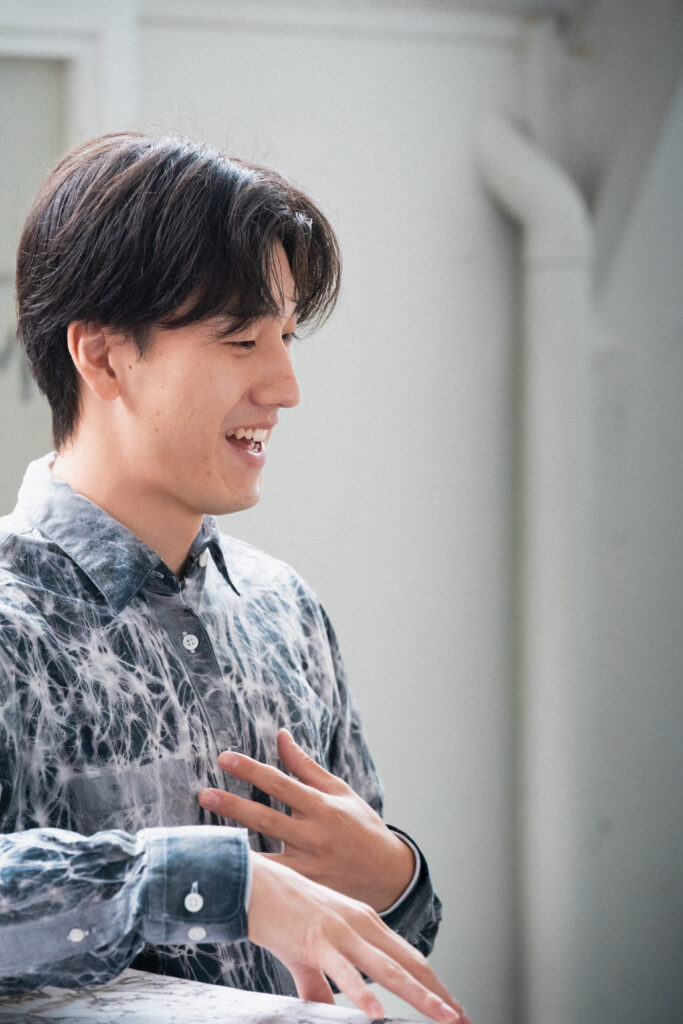
Their collaboration began in an unusually fast and direct way. Winterink contacted Ousuke the day after he registered on the MMP online platform. From there, the project quickly developed, starting with online communication, followed by discussions and experimentation in the Netherlands, and eventually leading to the production of the final work.
Ousuke explained that both partners shared a strong intention not to create an ordinary product. Their youth, he noted, was both a challenge and a strength, pushing them to explore how something genuinely new could be created rather than simply extending existing design approaches.

He also highlighted a key difference in process: in many European design workflows, the designer’s proposal leads development, and the maker responds to it. In this case, however, Winterink began by exploring what kinds of design possibilities could emerge directly from the Roketsu technique itself.
Winterink described the collaboration as an opportunity to deeply engage with both Roketsu dyeing (ろうけつ染め) and Shobien Kyoto’s production methods. Together, they explored how precise pattern control and the organic cracking that appears during dyeing could be reinterpreted. The balance between control and chance, tradition and contemporary design, became a central and highly stimulating theme throughout the process.
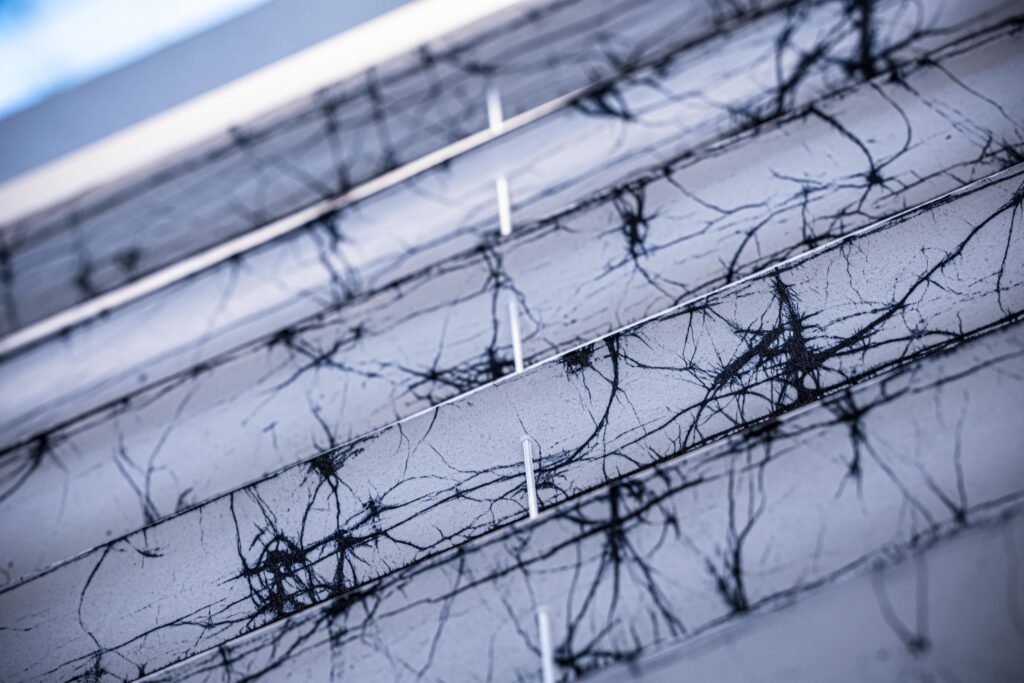
Collaborative Product: Blind (ブラインド)
The result is a textile blind (ブラインド) in which even the pleats are formed during the dyeing process. The cracking patterns are carefully controlled to achieve balance, resulting in a surface that is structured yet expressive. Rather than simply blocking light, the product allows light to become an active presence, interacting with the textile to create atmosphere and character within a space.
What Makes Collaboration Work
Ousuke shared that he has always believed Japanese craftspeople are among the best in the world, and through the programme he was able to experience firsthand how strongly Dutch designers respect Japanese craftsmanship. He noted that this respect goes beyond visual appreciation and extends deeply into technical understanding.
He also reflected that while Shobien Kyoto has traditionally operated within B2B production of noren (暖簾), the collaboration opened up new possibilities for expansion into B2C markets.
Winterink emphasized that the collaboration allowed her to deeply explore the beauty of Roketsu dyeing (ろうけつ染め) and Shobien Kyoto’s production methods. The team studied how precision in patterning and the unexpected organic cracks formed during dyeing could be used as intentional design elements. The balance between control and chance: traditional technique and contemporary perspective—became a central and highly stimulating process.

MMP 2026 Open Call
The MMP 2026 Open Call is approaching its closing phase soon. If you are looking to develop a new project through cross-cultural collaboration, the MONO MAKERS PROGRAM (MMP) can be your chance.
Please check the full application requirements and submit your application in time.
For inquiries: info@monojapan.nl
Open Call deadline: May 22, 2026